Launch Report, Bayboro, February 25-26, 2017

A weekend of really good weather in the North Carolina winter is guaranteed to bring out a lot of enthusiasts, and last weekend was a really good example.?? The eastern part of the state is experiencing an unusually warm winter, and this weekend felt like April!? Saturday was way too hot for anything but a T-shirt (but windy) and a cold front moved through overnight, but Sunday way very calm for Bayboro.? Clear blue skies both days ? the weather was perfect, and because of this, the attendance exceeded anything we have ever seen before at this field.? At one point on Saturday I counted 36 cars and trucks on site.? Another interesting facet of this weekend?s gathering was that is was almost exclusively a ?high-power? weekend.? A look at the motor use summary will show what I mean.

Size Sat Sun Both
C 1 1
D
E 1 2 3
F 3 3
G 7 2 9
H 2 3 5
I 8 2 10
J 4 4 8
K 4 2 6
L 1 2 3
M 1 2 3
Total 29 22 51


Any launch where the total number of J motors exceeds the total of all C, D, E, and F motors flown, is, by definition, a high-power launch.? I?ll run through the highlights of Saturday and then move on to Sunday.

Dan Fritsch brought out a new rocket, a 3? scratch-built device painted in the sky-blue and white of the University of North Carolina at Chapel Hill (Dan?s home town), which he had named Starheel.? The undergraduates from NC State University in Raleigh were very impressed with the grace of the rocket and the beauty of the paint job, but tried very hard not to show it.

Allan Rose recovered from a nasty crash in December and recertified level 1 (TRA) with his I-Roc powered by an Aerotech I366R.? Greg Twiss also earned the NAR level 1 certification because his rocket that was flown in December and never found, was returned to the club in perfect shape in January.? We have some very good neighbors at the field in Pamlico County, if you get a chance to meet them, be sure to say thanks for helping us out with rocket recovery.

Matt Fletcher was also very intent on certification this weekend.? He passed the TRA written exam, and then flew a skinny? carbon fiber kit called Binary Sushi on a K700 for a successful cert flight.? The main parachute came out at apogee, and Matt had a very long walk to bring that one back, but it was in fine shape when it came home.

While we?re on the subject of certification flights, let?s introduce Saturday?s main event:? Joe Hill brought out a new rocket and successfully certified Level 3 with the TRA organization.? This was a big event for me (I?ve known Joe since he was about 8 or 9), it was a very big event for his Dad, Dennis Hill, and it was clearly a huge event for Joe, who almost needed auxilliary oxygen at several points during the day!!??? When the deal finally went down (recorded by a professional video photographer, no less),? Joe?s rocket, called Short Spoon, equipped with an Aerotech M1780NT, flew and recovered perfectly, and there was not a single person on the field who was surprised.

The NCSU high Power Rocketry Club finished up the construction of their full-scale model, called Vesuvius, and flew it on the Aerotech L2200G.? The engineering goal this year is to build a payload section that visually scans the ground and tracks the position of a contrasting patch of ground cover.? After a few little problems and false starts, they got the rocket launched perfectly.? The problems started on the way down, when an eye-bolt backed out and the fin section came down ?without benefit of parachute?.? This problem meant that some other portion of the structure was hanging from a parachute that was A LOT larger than it needed, especially in 20 MPH winds gusting up to about 30 MPH.? We watched helplessly as this parachute got blown all the way to the tree line 2.4 miles to the Northeast.? With the help of the farmer who works the section of land on that section of the field, all of that section came home safe and sound, but a little beat up.? The team will have time to get this little problem fixed and make a qualifying flight before we go to Huntsville.

As the sun was going down on a fantastic day of rocket flying, Charlie Ogino launched a small carbon fiber rocket from Carolina Composite Rocketry called MECO on a K935 motor (which I can?t find in my listings, so it may be an EX motor).?? This little bullet flew to the 13,000 to 14,000 range and was finally recovered ?way over yonder?.

Sunday

Sunday was a little chilly, if you had become accustomed to the Havana-style February we have been enjoying, but still about 30 degrees warmer than the usual February launch.? The important factor was that the wind had died down to almost nothing.? The big guns came out early.? Jim Livingston and Alan Whitmore both had 115mm homemade M motors ?in the box?, and got them on the pads before the local church services were finished.? Livingston?s rebuilt Viper flew to about 3600 feet and Whitmore?s Spork II made it up to about 9300 feet, and both were recovered perfectly.

Robbie Kirk was busy all day, flying a pile of rockets on motors in the E through H range.? Robbie was working a lot with the Jolly Logic parachute deployment device, learning the details of how It operates and impressing everybody with its simplicity and effectiveness.

Charlie Ogino attempted an airstart arrangement in his Little John, with a central K700 staging to 2 H123W?s.? The H?s did not light up, but everything deployed the chutes and came home safe.

CJ Lucas absolutely aced the difficult NAR level 2 written exam, and then had some trouble with the Jolly Logic device that prevented his full L2 certification.? CJ will be back in March to finish off that job.? Kurt Hesse flew his Performer 98 on a homemade 3 grain 76mm L motor that performed flawlessly.

Sunday is usually the day that your prefect can relax and prep rockets and just fly, after a busy Saturday, but this Sunday was a little bit different – I was busier than a conflict-of-interest investigator in the the Trump White House.? Ken Allen brought his trailer back to sell some motor supplies, and regulars like Mike Nay, Charles Long, Joe Hill, Chuck Hall, Eddie Haith were very active all day.

It was a great weekend, with lots of memorable flights and lots of time hanging out with good friends.? ??A weekend that will stick in my memory.

Post-script

The NC State High Power Rocketry Club returned to Bayboro for a special one-off launch on Sunday, March 19, and completed a successful qualifying flight.? Congratulations!!! ?And on to Huntsville.

Alan Whitmore

Prefect, Tripoli East NC
Posted in Launch Reports | Comments Off on Launch Report, Bayboro, February 25-26, 2017

Launch Report, Butner, February 4, 2017

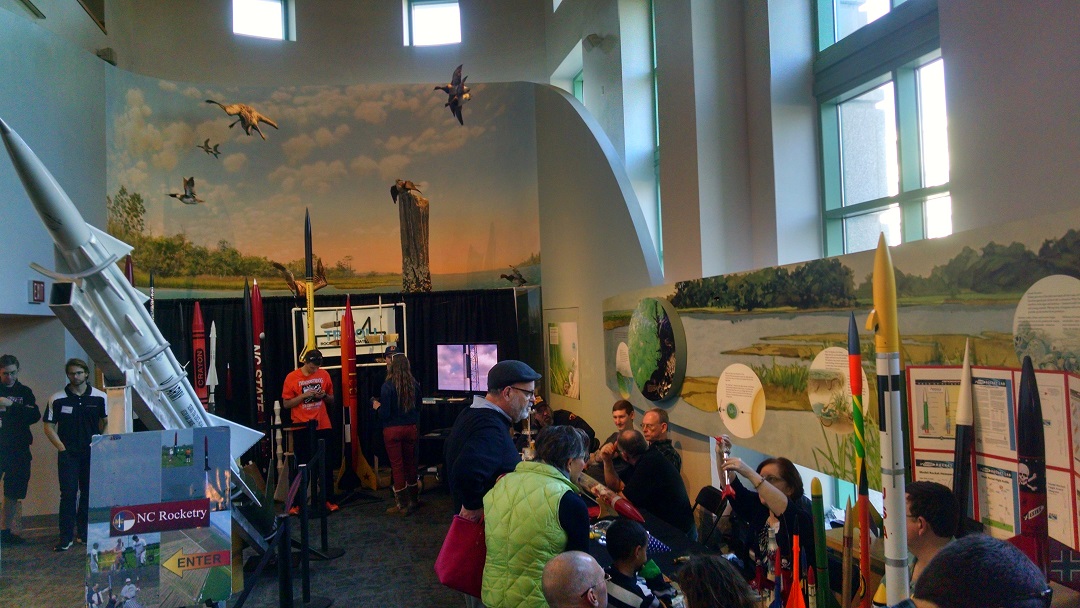
Every year we have an exhibit at Astronomy Days in late January to introduce people to the hobby of model rocketry. We get a lot of people asking about launches local to the Triangle.

IMG_20170128_103720732

We have scheduled launches in Butner, but only in the summer. To get people who are interested out to a launch as soon as possible, we have held a launch in Butner the week after Astronomy Days for the last few years.

Sometimes we get a nice warm weekend in February, but not so this year. Highs were in the low 40s. At least the winds were very light. We were set up and ready to fly at 10AM, but most people did not show up until noon or so.

We had a total of 30 flights, ranging from B to G motors. No high power H flights this time.

Motor Size Flights
B 1
C 10
D 2
E 1
F 9
G 7
Total 30

Chef Paul Schaefer brought his rocket grill and tried to keep us all warm with burgers and other food. He is still raising money for the launch of his half scale Nike Ajax (seen in the picture above).

IMG_20170204_143456151

Dan Fritz and Mike Nay kept people entertained with many G powered flights. A loud G75 Metalstorm in Mike’s G-force really woke up the crowd.

Dan and Mike had many flights using a Jolly Logic Chute Release to delay opening the main parachute until a low altitude. Normally these have been working fine, but I witnessed some failures to open the chutes at this launch. Hopefully they have figured out what the problem(s) were. If you are using a Chute Release you may want to consult them, as they seem to have the most experience with the device.

The two Jordan High School TARC teams were at the launch testing out their egg carrying rockets and a new 12 foot 1010 rail. Hopefully the longer rail will result in straighter flights and less variation from flight to flight. The TARC objective this year is to fly to exactly 775 feet and stay in the air for 41-43 seconds. Repeat performance is a key.?They has a total of 6 F39-7 powered flights.

Mike Nay tried a two stage Estes Ascender using two F15 motors. As expected, the low thrust F15 did not have enough power to get the rocket moving fast enough off the rod. It had a nice arcing ballistic flight and was recovered at the edge of the field?in good shape. Switching to a 1010 rail would be a good idea for the heavier Estes Pro Series rockets using the low thrust E and F motors.

Aaron and Paul Schaefer, as well as Aaron’s friend Travis, flew most of the C flights in a variety of small rockets.

Jackson Fuller, 5 years old, was a new flyer at our launches, I believe. He flew an Estes Flash on a C6-5. Young Mansour Mohamed was back for a single flight of a red/silver Estes rocket on a C6-5.

Jimmy Blackley entertained us with a had a single flight with a Big Daddy and an F26 black smoke motor.

We had a few cars of new spectators who saw us at Astronomy Days. Hopefully we will see them again with rockets in the summer.

For the summer Butner launches, we now have two 1010 rail launches, one with a 12 foot rail, and one with the standard 8 foot rail. We should be able to avoid launch rail congestion this year. We also have up to seven low power launch pads with 1/8″, 3/16″ and 1/4″ rods. We also have?a 6?foot 80/20 20mm mini rail. It?is a?good replacement for the low power rods, and I encourage people to use it.

I hope to see you all in Butner during the warm summer months.

Dave Morey


Posted in Launch Reports | Comments Off on Launch Report, Butner, February 4, 2017

Launch Report, Bayboro, January 21, 2017

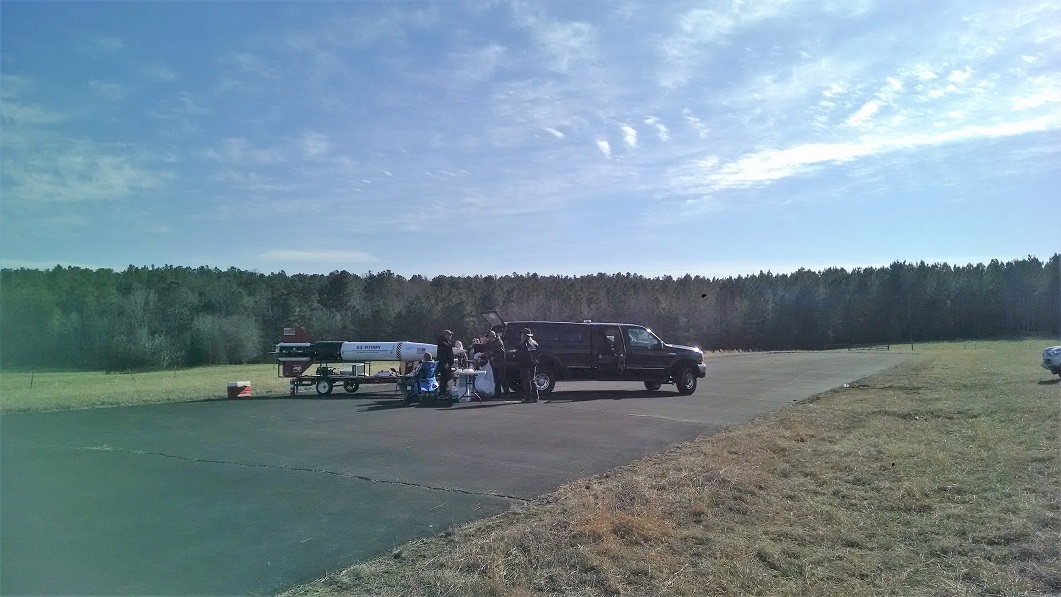
Winter weather in coastal North Carolina is always the biggest variable we have to deal with in our hobby.? This month the forecast for the weekend of January 21-22 was about as bad as we have seen it except for the weekend of Hurricane Matthew back in the fall.? Sixty percent chance of rain on Saturday and 100 percent chance on Sunday.? Hopeless, right?? The only thing I have learned beyond any doubt in the last 10 years of running a launch at Bayboro is to take the weather forecast, add the word ?maybe?, and get in the truck and go anyway.? I left Chapel Hill at 6:00 AM on Saturday in a fog so thick that I could not see the end of the driveway.? The roads and fields were filled with mist and murky fog all the way to New Bern.? The sky began to lighten up as I crossed the river, and by the time I got the trailer to the field, visibility was beginning to stretch out.? The ceiling was still very low, however, and I could not see the top of the temporary tower that has been erected north of the current launch site ? which is about 150 feet high.? The cloud deck moved up gradually all day long, and by mid-afternoon the ceiling was up to 1500-1800 feet broken to 4000.

Only the hardest of the hard core were there early to help with the set-up, Jim Livingston and Chuck Hall, but by about 10:30 people started pouring in and we ended up staying busy all day.? Motor use summary?

Size Sat
A 1
B 2
C 2
D 1
E 3
F 6
G 6
H 7
I 9
J 2
K 3
Total 42


I am always interested in advertising the new flyers, because they are the future of our club.? Elijah Maybee brought a new rocket with him to fill up the lower end of the motor range.? Thanks to Natalie Harrell for helping to get him sorted out with parachute packing and motor installation.? Sam DeLong was one of the flyers who used to gather at the field at Fentress, and has recently moved to Wilminton, NC.? Sam brought a set of gorgeous mid-power rockets, at least 2 of which were scratch-built, and flew them on motors in the G through I range.? Beautiful flights and good parachute recovery, but I think one of them is still in the field, the Patriot, which was launched on a CTI I242W.

Mike Collier came to pick up his Safety First, which was found in the corn last month, and stayed to fly a bunch of rockets.? The flight that sticks in my mind is the flight of his small V2 on an Estes E9.? This is one of the few V2s that I have watched that did not ?wag its tail? after motor burnout.? Eddie Haith brought a new rocket, the Estes Ascender, and made several flights with the black powder F15 motor.

Our academic teams did extremely well this weekend.? The North Carolina School of Science and Math TARC team made four very impressive flights with their rocket Halo on an Aerotech F39T, and gathered a lot of information that will be useful for dialing in their rocket for qualifying flights later this winter.? The North Carolina State University High Power Rocketry Club needed to get the fine tuning done on their subscale model to get the several separation stages done right and to get the parachutes to come out at the right time, and this time they nailed it perfectly!? Their rocket, named Red Rocket, even though it wasn?t, flew on one of the new Aerotech K1103X motors and performed perfectly.

Joe Hill had 2 flights, the first with his Frenzy Primus on a 6-grain 38mm motor that Jim Livingston made from the extremely fast-burn formula called ?Jim Scarpine Tribute Blue?, and a later flight with the PeeDee on an Aerotech I600R.? The action got thick and fast as the day ended, and I am not sure that that one made it back home, either.? By about 3:30 the wind had shifted from out of the east to a more northerly direction, the only really bad wind direction at this field, as it blows the rockets toward the closest tree line, about 0.7 miles away.

I was delighted to see four Aerotech G64W?s flown this weekend, one of my favorite motors.? Dan Fritsch fliew one in his Pyramid, Eddie Haith used one for his Big Orange, CJ Lucas flew the DarkStar Lite on another one, and Sam DeLong tried one in his Stinger.? I left my only 29/40-120 casing hanging in a tree deep within the malarial black-water swamps at Battleboro in 2007, and I really need to buy another .

The homemade propellant group was represented by Kurt Hesse and Jim Livingston, both of whom flew successfully in their own rockets and supplied others with motors with which to make extremely exciting flights.

Join us at the Museum of Natural Sciences on the weekend of January 28-29 if you can, and, if not, come out to Bayboro February 25-26 for some more high-power adventures.

One of our flyers brought back a rocket that had obviously been lying in the field for a long time, probably more than a year.? The plywood fins had rotted away to mush, and green slime was growing on the 4? diameter white-painted body tube.? It had an Aerotech 38/600 case in it, which was removed from the rocket and we will make an attempt to clean it and see if it is still usable.? The most unusual feature of this rocket is the parachute, which is about 36? to 38? in diameter, black and white, and has the word IRIS embroidered on the white part.? This is an extremely unusual parachute, it has little plastic rings sewn around the edge of the canopy and the shroud lines are tied to the rings.? The parachute is in good condition, the motor case may be usable, and the nose cone is probably salvageable, but the rest is waterlogged and rotted away.? If this is your rocket, drop me an email.

Alan Whitmore

Prefect, Tripoli East NC
Posted in Launch Reports | Comments Off on Launch Report, Bayboro, January 21, 2017